The Systematic Approach to Tennis Improvement with a Practice Log Book
For many tennis players, practice is an intuitive affair—a collection of drills, matches, and strokes repeated with the hope of gradual improvement. While passion and repetition are essential, they often lack the structure needed for targeted, measurable progress. This is where a dedicated Tennis Practice Log Book transforms a routine from haphazard to strategic. It serves not as a passive notebook, but as an active tool for planning, execution, and analysis, bridging the gap between effort and outcome.
Beyond Simple Notes: The Core Function of a Log Book
A Tennis Practice Log Book is more than a diary. It is a centralized hub for your athletic development. Its primary role is to create a documented workflow for your tennis journey. Before practice, it becomes a planning canvas where you set specific objectives for the session—perhaps focusing on second-serve consistency or net approach shots. During practice, it offers a quick-reference structure to note observations, successes, and immediate challenges without breaking focus. Afterward, it transitions into an analysis tool, allowing you to review what worked, what didn't, and why. This creates a closed-loop system where each session informs the next, preventing stagnation and fostering deliberate practice.
Integrating the Log into Your Tennis Workflow
The effectiveness of a Tennis Practice Log Book hinges on its seamless integration with your existing tools and routines. It interacts directly with your coaching sessions, video analysis software, and even fitness tracking apps. For instance, a coach's technical feedback on your forehand can be recorded in the log alongside your own subjective feel during drills. Later, when reviewing match footage, you can cross-reference the visual evidence with your logged notes on that same stroke. This synergy between external tools and personal documentation builds a richer, more accurate picture of your performance.
Consider the practical workflow of a player using the log:
- Pre-Session: The player reviews the previous session's notes, identifies a recurring issue (e.g., footwork on wide balls), and designs the next practice to address it. The log provides the historical data needed for this planning.
- In-Session: Between drills or during short breaks, the player jots down key metrics—serve percentage in a drill, mental state during a simulated pressure point, or physical energy levels. This captures real-time data often forgotten after a tough session.
- Post-Session: Within 24 hours, the player spends ten minutes expanding on the in-session notes, adding reflections on cause-and-effect, and setting a provisional focus for the next session. This habit ensures continuity.
Preparation and Long-Term Organization for Consistency
The utility of a Tennis Practice Log Book grows exponentially with consistent use. To facilitate this, the log's design must prioritize usability and organization. A well-structured interior, with dedicated sections for goals, session details, match results, equipment notes, and long-term progress charts, reduces the friction of entry. When you open the book, you know exactly where to record a specific piece of information. This eliminates the blank-page paralysis that can deter regular use.
For the long-term, this organization becomes a treasure trove of personal analytics. By maintaining a single, chronological record over months or a season, you can track patterns that are invisible in day-to-day awareness. You might discover that your backhand stability declines after a three-week break from specific drills, or that your winning percentage in matches correlates strongly with pre-match warm-up routines logged weeks earlier. This data-driven self-awareness is the hallmark of a professional approach, applicable to hobbyists and competitive athletes alike.
Practical Implementation Tips for Effective Logging
Starting with a Tennis Practice Log Book can feel daunting. The key is to begin simply and let the process evolve naturally.
- Start with the Obvious: For your first few entries, just log the basics: date, duration, primary focus, and one positive and one negative takeaway. This establishes the habit without overwhelm.
- Use it as a Decision-Making Tool: When deciding on new equipment, like strings or shoes, use your log to review past notes on comfort and performance. This turns subjective feel into comparative data.
- Combine Quantitative and Qualitative: Always blend measurable stats (unforced errors, first-serve percentage) with qualitative notes (confidence level, tactical comfort). The numbers tell the story, but the feelings explain it.
- Schedule Review Cycles: Set a monthly or quarterly reminder to skim through past entries. Look for trends, not just individual sessions. This high-level review guides your broader training phase planning.
The Role of a Print-Ready, KDP-Tested Interior
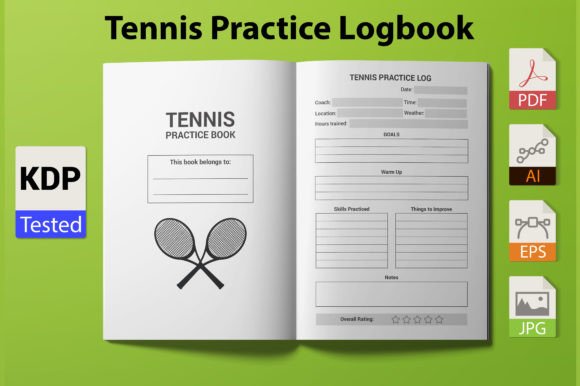
For creators, educators, or tennis enthusiasts looking to produce or utilize a professional log, the technical specifications of the tool matter. A print-ready Tennis Practice Log Book Interior, designed for Amazon KDP with 6x9 inch dimensions and tested for compatibility, ensures that the practical tool functions flawlessly in its physical form. The availability of files in PDF, AI, EPS, and JPG formats allows for flexibility. A PDF ready for upload means the creator can move directly to publishing, while the other file types enable customization for coaches or clubs wanting to tailor the log for their specific programs.
The choice of page count—100, 110, or 120—allows users to select a volume that matches their commitment level. A 100-page log might suit a seasonal player, while 120 pages could be ideal for a year-round competitor. The "no bleed" design is practical for a workbook meant for writing, keeping the focus on the functional interior layout rather on complex printing margins. This attention to detail in the asset's creation mirrors the attention to detail the log book encourages in the player's practice.
From Recording to Reflection: Enhancing Quality Control
At its highest level, a Tennis Practice Log Book becomes a system for quality control in your tennis development. By documenting not only what you did, but the context and results, you create a feedback loop that elevates the standard of each practice. You move from asking "Did I practice today?" to "Was my practice effective today, and how can I prove it?" This shift is crucial for anyone serious about improvement, whether their context is business, art, or sport. The log book forces accountability to oneself and provides the evidence to make smarter decisions about future time and resource allocation.
Ultimately, the integration of this tool is about making your practice process intentional. It sits at the center of your tennis ecosystem, connecting past experience, present action, and future planning. It interacts with your coach's advice, your fitness data, and your competitive goals. By adopting a systematic approach through logging, you ensure that every hour on the court is an investment, not just an activity. The physical log book, with its clean, ready-to-use interior, is the tangible catalyst for that transformation.