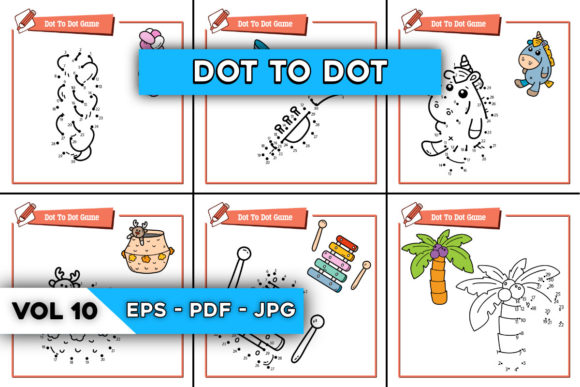
The Joy and Learning in 10 Dot to Dot Games for Kids: Vol 10
Dot to dot games, a staple of childhood activity books, are far more than simple line drawings. They are gateways to development, creativity, and quiet focus. A specific collection like 10 Dot to Dot Games for Kids: Vol 10 represents a curated experience, offering 10 distinct puzzles designed not only for entertainment but for foundational learning in drawing, sequencing, and coloring. This article explores the enduring significance of these puzzles, their role in modern childhood, and how resources designed for platforms like Amazon KDP provide invaluable tools for parents, educators, and creators.
Understanding Dot to Dot: More Than Connecting Points
At its core, a dot to dot puzzle presents a series of numbered points. The child's task is to connect these points in the correct numerical order, ultimately revealing a hidden image. This seemingly straightforward activity is a powerful educational tool. It teaches number sequence recognition, which is a fundamental math skill. For young children, navigating from 1 to 10, or higher, reinforces counting and ordinal knowledge. Furthermore, it demands fine motor control. The act of drawing a line from one precise point to another enhances hand-eye coordination and prepares children for writing and detailed artwork.
A common assumption is that dot to dot is purely for pre-schoolers. However, with increasingly complex puzzles featuring hundreds of points or non-sequential patterns (like alphabetical order), they can challenge and engage older children, making them a versatile learning resource across age groups.
The Specific Value of a Curated Collection: Vol 10
A volume like 10 Dot to Dot Games for Kids: Vol 10 offers structured variety. Ten different puzzles ensure that a child encounters multiple themes—perhaps animals, vehicles, space objects, or fairy tale characters. This variety prevents monotony and sparks different facets of a child's imagination. Each completed puzzle becomes a unique coloring page, doubling the creative output. The child first constructs the image through logical sequencing, then personalizes it through color choice and artistic expression. This two-stage process—build then color—mirrors foundational design thinking: conceive a structure, then embellish it.
The practical relevance for parents and educators is clear. Such a collection provides a ready-made, progressive activity set. It can be used for quiet time, travel entertainment, or as a supplementary educational tool in classrooms or homeschooling environments, seamlessly fitting into daily routines.
Modern Applications: From Paper to Platform
In today's digital age, the demand for tangible, screen-free activities for children remains high. Dot to dot books offer a tactile, focused experience that contrasts with the often fragmented attention demanded by tablets and phones. However, the creation and distribution of these resources have been transformed by technology.
Products designed for Amazon Kindle Direct Publishing (KDP) or other platforms, like the described 10 Dot to Dot Games for Kids: Vol 10 package, represent this modern intersection. The provided zip file—containing PDFs, JPG images, and an editable EPS file—is not just a product; it's a flexible toolkit.
- PDF 10 Pages: Ready for immediate printing or digital distribution as a complete book.
- JPG 10 Images: Allows for individual puzzle sharing, use in apps, or custom projects.
- EPS Editable File: Offers professional versatility. Educators or content creators can modify the puzzles, change numbers, adjust sizes, or integrate them into larger custom workbooks.
This multi-format approach speaks to the needs of modern life. A parent might print the PDF for a weekend activity. A teacher could use the JPGs in a classroom presentation. An entrepreneur on Amazon KDP might use the EPS file to create a branded series. The resource supports education, creativity, and business simultaneously.
Educational Integration and Cognitive Benefits
Within educational frameworks, dot to dot games are excellent for reinforcing multiple skills simultaneously. They are often used in early childhood curricula to support:
- Numerical Literacy: Sequential counting, number recognition.
- Cognitive Development: Following instructions, pattern prediction (What will this shape become?).
- Fine Motor Skills: Precision drawing, pencil control.
- Visual-Spatial Reasoning: Understanding how parts connect to form a whole.
- Patience and Concentration: The task requires sustained focus to completion.
After the connect-the-dots phase, the coloring activity fosters color knowledge, artistic choice, and even emotional expression—a child might color a lion fierce or friendly based on their feelings. This holistic development is why such puzzles have remained relevant for generations.
Clarifying Common Misunderstandings
Some may view dot to dot as a passive or "busy work" activity. This is a misconception. When engaged with properly, it is an active learning process. The child is not just tracing; they are decoding a numeric code to reveal a visual secret. The moment of revelation—when the abstract dots transform into a recognizable picture—provides a genuine sense of accomplishment and surprise, boosting confidence and motivation.
Another misunderstanding is that these games are only for learning to draw. While they undoubtedly aid in drawing skill by providing a guided structure, their primary strength is in the cognitive sequencing and executive function they develop. They teach a child to start a task, proceed step-by-step, and finish it—a valuable life skill beyond the art room.
Examples in Everyday Context
Imagine a child working on a puzzle from Vol 10 that eventually forms a rocket ship. They connect dots 1 through 30. Upon completion, they have not only a rocket but also a narrative. They might then color it with fiery exhaust and a blue starry background. This activity could naturally lead to conversations about space, physics, or exploration. The puzzle becomes a springboard for broader learning and storytelling, integrating seamlessly into daily playful education.
For the creator or publisher, the 10 different puzzles offer market appeal. Variety ensures broader customer satisfaction, as the book caters to diverse interests. The inclusion of an editable EPS file is a powerful example of catering to modern creator needs, allowing for adaptation and scalability in a digital marketplace.
Building a Broader Understanding
Dot to dot games, especially in thoughtfully assembled volumes, sit at a crossroads of play, education, and creative business. They are a classic toy that has evolved into a modern digital asset. Their purpose extends beyond keeping children occupied; they are tools for developing logical thinking, artistic confidence, and the simple joy of creating something from a hidden blueprint.
Their significance in modern life is highlighted by their dual existence as both a physical, calming activity and a digitally distributable, customizable product. In work and business, packages like the Vol 10 zip file empower solo entrepreneurs and educators to produce professional-quality materials. In education, they remain a trusted, multi-skill development resource. In daily activities, they provide that precious, focused time where a child is independently engaged in a constructive task.
Ultimately, resources like 10 Dot to Dot Games for Kids: Vol 10 remind us that foundational learning tools can be both simple and profound. By connecting dots, children are also connecting concepts: numbers to shapes, effort to result, and logic to creativity. For anyone looking to support a child's development or to create meaningful content, understanding the depth and versatility of these puzzles is the first step in appreciating their enduring value.