The Nurikabe Activity Book: A Creative Logic Challenge
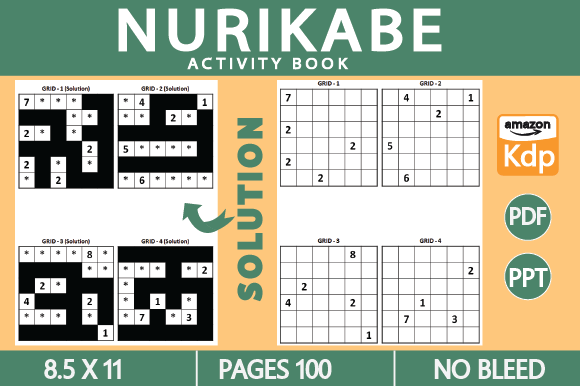
For creative professionals, educators, and puzzle enthusiasts, the quest for engaging content that stimulates the mind is constant. The Nurikabe Activity Book emerges as a uniquely structured resource designed to meet this need. This 100-page collection presents the intriguing Nurikabe logic puzzle in a clean, accessible format, ready for immediate use. Sized at a standard 8.5″x11″ inches with high-quality 300 DPI resolution, each puzzle is crafted for clarity, accompanied by its solution, and bundled within an editable PowerPoint file. This combination isn't just about providing puzzles; it's about offering a versatile toolkit for intellectual engagement and creative application.
What Makes Nurikabe a Unique Creative Tool
Nurikabe is a Japanese puzzle where the solver must paint a grid, determining which squares are "walls" and which are "islands" based on numerical clues. It requires deductive reasoning, spatial awareness, and a methodical approach. The inherent structure of Nurikabe puzzles—clean grids, logical progression, and a satisfying completion—makes them an excellent foundation for more than just solitary solving. The Activity Book captures this structure in a design that prioritizes usability. The absence of bleed simplifies handling, and the inclusion of both PDF and PowerPoint files transforms the book from a static product into a dynamic asset.
This dual-file approach is key. The PDF offers a pristine, ready-to-print version perfect for physical books or direct PDF uploads to platforms like Amazon KDP. The editable PowerPoint file, however, unlocks creative potential. It allows users to modify layouts, adjust difficulty sequences, integrate puzzles into larger documents, or even extract individual puzzles for use in custom worksheets, apps, or presentations. The logic puzzle becomes a modular component, adaptable to countless projects.
Creative Applications for Different Audiences
The utility of the Nurikabe Activity Book extends far beyond its pages. Its design invites adaptation, making it relevant to a spectrum of users from bloggers to business owners.
For educators and trainers, these puzzles are ready-made exercises for developing critical thinking and problem-solving skills in students or workshop participants. The editable format allows an educator to create themed workbooks, combine Nurikabe with other logic puzzles, or tailor the difficulty curve for a specific class. The solutions provided ensure guidance is always available.
Content creators, bloggers, and marketers can leverage the puzzles for audience engagement. A blogger focusing on brain teasers can use the high-quality images directly. A marketer might incorporate a simple Nurikabe puzzle into a newsletter or social media post as an interactive element to boost engagement. The clean, non-bleed design ensures the puzzles look professional in any digital context.
Freelancers and small business owners in the publishing or educational space can use the interior as a reliable, quality foundation for their own KDP activity books. By using the editable PowerPoint file, they can add their own branding, introductory text, or combine it with other interior designs to create a composite book, saving significant design time while ensuring a polished product.
For the hobbyist or puzzle enthusiast, the book serves its primary purpose beautifully: a substantial collection of challenges for personal enjoyment and mental exercise. The 100-page count offers depth, and the logical progression inherent in well-designed Nurikabe puzzles provides a satisfying sense of advancement.
Adapting the Format for Different Goals
The standard 8.5″x11″ inch size is a deliberate choice, aligning with common print and digital display formats. This consistency is a practical strength. When adapting the content, maintaining this clarity is crucial. For example, if extracting a puzzle for a mobile app, the 300 DPI quality ensures the image remains sharp when scaled. If integrating puzzles into a larger workbook, the no-bleed feature means they can be placed seamlessly alongside other elements without awkward margins.
Consider a project idea: creating a "Logic & Mindfulness" hybrid journal. Using the editable PowerPoint file, you could place a Nurikabe puzzle on one page, followed by a reflective writing prompt on the next. The puzzle engages the analytical mind, the prompt engages the reflective mind—the unified interior design provides a cohesive feel. Another idea: a puzzle-of-the-day calendar. The individual puzzles can be formatted into a calendar layout, offering a daily logical challenge.
The key to effective adaptation is to respect the puzzle's integrity while framing it appropriately for the new audience. For a children's activity book (adapted for older children), you might use the PowerPoint file to add more colorful, friendly borders or introductory instructions. For a corporate training manual, you might keep the design minimalist and add corporate branding only in the headers or footers.
Practical Recommendations for Use
To maximize the value of the Nurikabe Activity Book, approach it with a clear objective. Start by assessing your primary need: is it for immediate publication, for custom content creation, or for personal use?
- For KDP Publishers: Use the PDF directly for a straightforward, professional activity book interior. Ensure your cover design complements the clean, logical interior style.
- For Content Customizers: Open the PowerPoint file. Before making changes, duplicate the master slides to preserve the original. Modify elements like title fonts or page numbers consistently across the file to maintain a professional look. When adding new elements, ensure they do not clutter the puzzle grid itself, as clarity is paramount for the solver.
- For Digital Integrators: When saving individual puzzles for web or app use, export from PowerPoint at the highest resolution possible to retain the 300 DPI benefit. Consider adding a brief "How to Solve" guide alongside the puzzle if your audience is new to Nurikabe.
Organization is critical. The 100 pages are a resource; you might not use all at once. Plan your sequence or selection. If creating a graded difficulty book, you might rearrange puzzles from the file to create a smooth learning curve, starting with smaller grids and progressing to more complex ones.
Balancing Inspiration with Functional Design
The true creative potential of this resource lies in its intersection of structured content and flexible formatting. It inspires not through vague suggestions, but through tangible utility. A designer can think about visual themes to pair with the grids. An educator can think about pedagogical sequences. A blogger can brainstorm series topics around each puzzle's logical principle.
Keep the results audience-friendly by always testing. If you create a modified version, try solving a puzzle from the new format yourself. Is the grid still perfectly clear? Are any added instructions helpful, not distracting? Does the overall page feel balanced? This practical check ensures that creativity enhances the core experience rather than obscuring it.
The Nurikabe Activity Book, with its ready-to-upload interiors and editable foundation, ultimately serves as a catalyst. It provides the reliable, high-quality raw material—the logical puzzles—and the means to shape them. Whether your goal is to publish, educate, engage, or simply enjoy, it offers a clear path from idea to execution, grounding inspiration in a practical, usable format. By focusing on the needs of your specific audience and leveraging the adaptability of the files, you can transform this collection of logic puzzles into a tailored tool for thinking, teaching, and creating.