The Ultimate Customizable Log Book for Tracking Anything
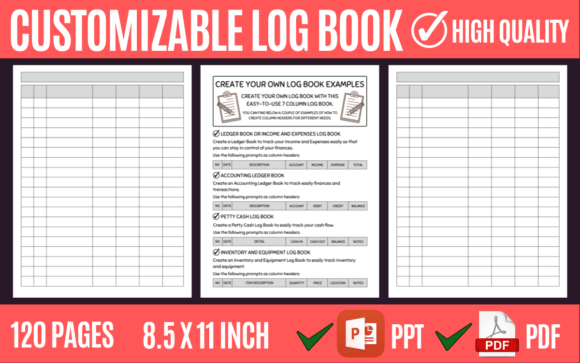
In a world of rigid templates and predefined forms, true flexibility is a rare gift. Imagine a log book that doesn’t tell you what to track, but instead asks you, "What matters to you?" This is the core of a Customizable Log Book. Built around a simple, powerful framework of seven columns with empty headers, it transforms from a blank slate into the exact tool you need, whether you're managing a business, pursuing a hobby, or organizing your life. It’s not just a book; it’s an invitation to design your own system.
Beyond Pre-Printed Pages: The Power of a Blank Framework
Most log books come with fixed columns—Date, Description, Amount—forcing your unique data into their generic mold. A Customizable Log Book flips this model. Its emptiness is its greatest feature. You assign the meaning. That first column could be "Client Name," "Plant Species," "Batch Number," or "Meeting Location." This fundamental shift from passive recording to active design makes the tool adaptable to virtually any scenario. It respects the complexity and individuality of your projects.
The seven-column structure provides enough space for detailed tracking without becoming overwhelming. It’s a canvas waiting for your labels. This approach is profoundly useful because it aligns the tool perfectly with your specific goals, not the publisher’s assumptions. You are not adapting to the log book; the log book is adapting to you.
Creative Applications: From Ledgers to Life Logs
The potential applications stretch as far as your imagination. While traditional uses like Income and Expenses or Vehicle Maintenance are perfectly served, the true creativity begins when you step outside conventional categories.
For Entrepreneurs and Freelancers
Beyond basic accounting, use it as a Project Touchpoint Log. Headers like: Date, Client, Contact Method, Discussion Topic, Next Action, Deadline, Status. This turns casual client interactions into a manageable workflow. Or create a Content Creation Tracker: Topic, Platform, Draft Stage, Keywords, Publishing Date, Engagement Metrics, Notes. It visualizes your entire content strategy across blogs, social media, and newsletters.
For Creators and Hobbyists
Track your Art Supply Inventory & Usage: Material, Color/Code, Quantity Used, Project Name, Cost Per Use, Storage Location, Condition. A gardener might design a Plant Propagation Log: Species, Propagation Date, Method (seed/cutting), Source, Success Rate, Transplant Date, Observations. It turns a passionate activity into a documented, learnable science.
For Educators and Community Organizers
Design a Classroom Resource Log: Resource Name, Type (book/manipulative), Subject, Checkout Student, Date Out, Date Returned, Condition. Or a Volunteer Coordination Sheet: Volunteer Name, Task Assigned, Date, Hours Committed, Hours Completed, Contact Info, Notes. It brings order and appreciation to collaborative efforts.
Designing Your Log: Principles for Clarity and Consistency
The freedom to customize requires a bit of strategy to ensure your log remains effective and easy to use.
- Start with the Outcome: Before labeling columns, ask: "What decision or insight do I want from this data?" If you need to know cash flow, columns like Cash In, Cash Out, and Balance are essential. If you're tracking mileage for reimbursement, Odometer Start, Odometer End, and Total Mileage become critical.
- Keep Headers Clear and Distinct: Avoid vague headers like "Info" or "Details." Be specific: "Supplier Name," "Error Code," "Temperature Setting." Ensure each column captures a unique data type to prevent overlap and confusion.
- Plan for Entry Simplicity: Design for the person who will fill it in, often you in a busy moment. If "Payment Method" is a column, will you write "Credit Card," "CC," or "Visa"? Decide on a standard abbreviation or format upfront to maintain consistency.
- Include a Notes Column: Almost any log benefits from a final column reserved for Notes, Observations, or Next Steps. This captures the context that rigid data doesn't, turning rows of information into a rich narrative.
Adapting the Framework for Different Formats
The seven-column concept isn't confined to a physical book. This framework can be migrated to digital tools, shared documents, or even whiteboards for team projects.
For a digital spreadsheet, the same principle applies: create your seven columns with your custom headers. The advantage here is sorting, filtering, and calculation. Your Customizable Log Book template becomes a dynamic database. For collaborative contexts, such as a team managing equipment, the defined columns (Item Description, Quantity, Location, Checkout To, Date Out, Due Date, Notes) create a shared language and process, ensuring everyone logs data the same way.
Real-World Example: A Freelancer’s Hybrid System
A freelance photographer might use a physical Customizable Log Book on their desk for quick daily captures: Session Date, Client, Shoot Type, Hours On-Site, Equipment Used, Expenses Incurred, Quick Follow-Up Note. Later, they transfer this to a digital spreadsheet for deeper analysis, using the same column headers to calculate monthly project averages, expense trends, and equipment utilization rates. The physical book offers tactile, quick-access logging; the digital version offers strategic insight. The framework bridges both.
Sustaining the Practice: Making Logging a Habit
The best-designed log is useless if it isn't used. Integrate it into your existing routines. Place your Customizable Log Book next to your point-of-sale system, in your vehicle's glove box, or beside your main work tool. The act of logging should take seconds, not minutes. If you find yourself skipping entries, review your column headers—they might be too complex or capturing unnecessary data. Simplify. The goal is actionable record-keeping, not archival perfection.
Periodically review your log. Is it providing the insight you wanted? Are you noticing patterns in your Inventory Log that suggest a different supplier? Does your Daily Activity Log reveal where your time is most productive? This review turns data into intelligence and might even prompt you to redesign a column, adapting your tool as your needs evolve. The Customizable Log Book is a living system.
From Tracking to Insight: The Ultimate Goal
A Customizable Log Book begins as an organizational tool but matures into a source of empowerment. Tracking income and expenses reveals the financial health of your passion project. Logging vehicle maintenance prevents costly surprises. Recording daily activities provides undeniable evidence of your productivity. It moves you from feeling overwhelmed by details to understanding them.
This blank-column approach champions a mindset of intentionality. You decide what's worth measuring. In doing so, you create a mirror that reflects the true shape of your efforts, your business, or your hobby. It’s a practical step toward not just managing your world, but actively designing it.