The Strategic Coach's Tool: Leveraging a Volleyball Playbook for Team Development
In the dynamic world of volleyball coaching, organization and clear communication are as vital as physical training. While drills and practice sessions build skill, the strategic framework of a team often resides in the coach's mind and scattered notes. The formalization of this strategy into a tangible, structured document can transform a team's coherence and performance. This is where the concept of a dedicated volleyball playbook becomes invaluable, and for coaches looking to create one, a specialized Volleyball Playbook KDP Interior offers a streamlined, professional solution.
Beyond the Clipboard: The Anatomy of a Functional Playbook
A volleyball playbook is far more than a collection of plays. It is the central repository for a team's identity. It typically encompasses system philosophies (like offensive and defensive base formations), specific play diagrams for various scenarios, rotational charts, personnel assignments, and even sections for conditioning schedules and game-day protocols. For a youth team, it might focus on fundamental positioning. For a competitive high school or club team, it could detail complex offensive combinations and defensive adjustments against different opponent types. The key is that it provides a consistent reference point, eliminating ambiguity and ensuring every player understands their role within the larger system.
Why a Standardized Interior Makes Sense
Many coaches start this process with a blank notebook or a basic word processor document. However, this often leads to inconsistent formatting, diagrams that are difficult to draw clearly, and a final product that lacks the polished authority of a professional manual. Utilizing a pre-designed Volleyball Playbook KDP Interior addresses these practical hurdles. Such an interior provides a ready-made structure with appropriately placed sections, uniform page layouts, and design elements suited to the content. This allows the coach to focus entirely on the strategic content—the plays, the notes, the assignments—rather than struggling with page design and alignment. The result is a cleaner, more usable document that players are more likely to respect and engage with.
Primary Applications and User Scenarios
The utility of a well-produced volleyball playbook extends across multiple levels of the sport.
- Educational Institutions: High school and college coaches can use it as the official team manual, distributing copies to varsity and junior varsity players to ensure system continuity across squad levels.
- Club Programs: In competitive club volleyball, where teams may practice intensively for specific tournaments, a playbook helps rapidly onboard players and establish a complex tactical framework quickly.
- Recreational Coaches: Even for adult recreational leagues or youth development programs, a simplified playbook helps teach basic positional rules and rotation patterns, serving as an educational tool.
- Individual Analysts: Dedicated players or assistant coaches might use a personal playbook to study opponent tendencies or log their own performance notes within the team's system.
In each case, the physicality of the book matters. Having a printed, bound copy in hand during film sessions, at practice, or before a game is fundamentally different from scrolling through a digital file on a phone. It encourages deeper study and serves as a tangible symbol of team commitment.
Characteristics of a KDP-Ready Playbook Interior
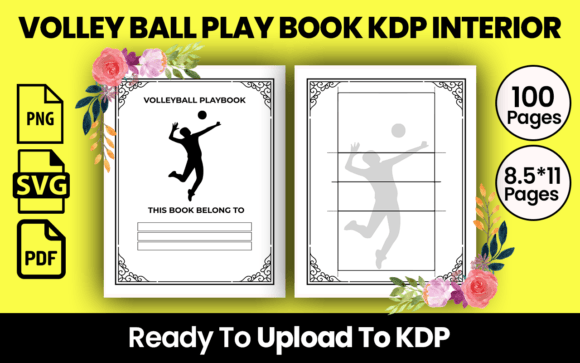
When considering a Volleyball Playbook KDP Interior for publication, certain technical and design characteristics ensure its readiness for real-world use and commercial distribution. The interior is typically formatted for the standard trim size of 8.5" x 11", a familiar and practical dimension for manuals. Being "KDP Tested" means the files are configured to meet Amazon's Kindle Direct Publishing requirements, ensuring smooth upload and print-on-demand fulfillment. High-quality, 300 PPI resolution guarantees that any embedded diagrams, logos, or text appear sharp in the final printed product.
A critical feature is the provision of multiple page count variants, such as 100, 110, and 120 pages. This offers flexibility, allowing a coach to select the length that best fits their team's needs without having to manually adjust layouts. The inclusion of different file types—PDF for final printing, PPT for potential customization, Ai and PNG for high-quality graphic elements—provides versatility for the creator. The use of CMYK color mode is essential for accurate printed color reproduction, and a "No Bleed" design is suitable for interiors where full-bleed images are not required, simplifying the printing process. These combined features make the product a pragmatic foundation for creating a professional-grade team document.
Integrating the Playbook into Coaching Workflows
The adoption process is straightforward. A coach acquires the KDP interior template, then populates it with their specific content. This involves filling pre-labeled sections with system explanations, using the provided page layouts to draw or paste in play diagrams, and adding rosters or statistics tables. The structured template prevents the common issue of content running onto pages awkwardly or diagrams being cramped. Once populated, the final PDF is uploaded to a platform like Amazon KDP. The coach can then order physical copies for their team or, if they choose, list the playbook for sale to other coaches, leveraging their own strategic expertise. The workflow thus moves from conceptual strategy to a distributable, professional product with minimal technical barrier.
Observations on Advantages and Practical Considerations
The primary advantage of using such a specialized interior is efficiency. It compresses the time from idea to physical product dramatically. Furthermore, it elevates the perceived quality of the coach's work. A player receiving a professionally formatted playbook is more likely to treat it as an important resource. From a broader perspective, it also contributes to the standardization of coaching materials within the sport, encouraging a more organized approach to tactical education.
Considerations for a coach would involve selecting the right page count variant to avoid a book that is too sparse or overly padded. They must also ensure their drawn diagrams are clear and legible when placed into the template. While the interior handles the design framework, the quality of the inserted content remains the coach's responsibility. The template facilitates the process but does not substitute for the coach's strategic knowledge. It is a tool for presentation, not a generator of content.
In essence, the move from an ad-hoc collection of notes to a formal volleyball playbook represents a step toward professionalized coaching. The availability of a ready-made, high-quality Volleyball Playbook KDP Interior supports this step by removing the design and formatting obstacles. It allows coaches, whether professionals guiding elite teams or volunteers teaching beginners, to channel their energy into developing their team's strategy and knowledge, ultimately creating a more focused, unified, and prepared squad. The playbook becomes not just a set of instructions, but a cornerstone of team culture and competitive readiness.